Which Behavioral Health EHRs Integrate With Wearables?
A narrow, specific capability most platforms in this category were never built around
 Mariam Shaker5 min read
Key takeaways
- Most behavioral health EHRs do not integrate with wearables at all; it is a narrow, specific capability, not a common feature.
- Oasys connects to Apple Watch, Oura Ring, Strava, and Flo, feeding physiological and behavioral data directly into the clinical record.
- Real integration means data lands inside the record automatically, not a manual export or a separate dashboard.
- Clinicians describe pulling up a client's actual sleep or activity data live in session, alongside self-report.
- This matters most for integrated, somatic, or holistic practices, not every therapy practice.
Short answer: most do not. Ask "does your EHR support wearables" to the category broadly and the honest answer is no, it is a narrow, specific capability that most platforms were never built around. Oasys is the one with real, built-in wearable integration, connecting to Apple Watch, Oura Ring, Strava, and Flo, so physiological and behavioral data feeds directly into the clinical record rather than living in a separate app a clinician has to check on their own.
This draws on Oasys's ongoing conversations with practice owners doing integrated or holistic work, and on Oasys's own build: wearable integration is not a bolt-on partnership, it is a real data pipeline into the record. That distinction matters, because "integrates with wearables" can mean anything from a genuine live data feed to a vendor logo on a partnerships page.
Below is what real wearable integration actually requires, which devices actually connect, what clinicians do with the data in session, and who this capability is actually for.
What "integrates with wearables" actually requires
Three things, not one. First, an actual data connection to consumer devices, not a manual upload a client does themselves. Second, that data landing inside the clinical record, not a separate dashboard the clinician has to open independently. Third, the data being current enough to be useful in session, not a monthly export.
Oasys connects client wearable and health-app data directly into the record those clients are already seen in, so a clinician reviewing a chart sees physiological data in the same place as the session note, not as a separate login.
Which devices actually connect
Oasys integrates with Apple Watch, Oura Ring, Strava, and Flo. Between them, that covers sleep tracking, heart rate and activity data, exercise and movement patterns, and cycle and health tracking, the categories of physiological and behavioral data that come up most often in therapy conversations about sleep, mood, energy, and physical wellbeing.
This is a narrow list by design. Most platforms in this category do not connect to any consumer wearable at all, which is why the honest answer to "which EHRs integrate with wearables" is a short list, not a feature most vendors offer in some form.
What clinicians actually do with the data in session
The value is not the data existing. It is the data being available at the moment it is clinically useful. One practice using Oasys describes it directly: when a client reports insomnia, the clinician can pull up the client's actual sleep data together with them in the session, seeing the physiology alongside the story rather than relying on the client's memory of a bad week.
Another practice built its entire model around this: wearable health data connects into the client record automatically, so progress on the physical side of wellbeing shows up in something the practice and the client can both see, not just describe. For a practice doing integrated or somatic-adjacent work, that turns a subjective "I've been sleeping badly" into an actual sleep pattern both people are looking at.
Why most EHRs do not have this
Most behavioral health EHRs are built around documentation, scheduling, and billing, which is where the vast majority of demand sits. A wearable data pipeline is a genuinely different engineering problem, ongoing device API integrations, data normalization across device types, and a place in the clinical record for physiological data to actually live, and most platforms have had no reason to build it. This is not a knock on those platforms. It is a real capability gap, narrow but real, for the specific practices that want it.
Who this is actually for
Not every practice. A talk-therapy practice with no clinical use for sleep or activity data does not need this, and should not weigh it heavily in an EHR decision. It matters for practices doing integrated, somatic, or holistic work, where physiological data is part of the clinical picture, and for clinicians who specifically want objective data to sit alongside a client's self-report rather than replace it.
What to ask before you commit to a platform
Does the platform connect directly to consumer wearables, or does it require a manual export from the client?
Which specific devices does it support, and does that match what your clients actually use?
Does the data land inside the clinical record, or in a separate dashboard the clinician has to check on its own?
Is the data current enough to review live in a session, or is it a delayed export?
How Oasys handles it
Oasys connects to Apple Watch, Oura Ring, Strava, and Flo, feeding physiological and behavioral data directly into the client record clinicians already work from. It is not a partnership logo or a manual upload; it is a real data pipeline landing in the same place as the session note.
Frequently asked questions
- Do most behavioral health EHRs support wearable devices?
No. Wearable integration is a narrow, specific capability most platforms in this category were never built around. It is worth confirming directly with any vendor rather than assuming it exists.
- Which wearable devices does Oasys integrate with?
Apple Watch, Oura Ring, Strava, and Flo, covering sleep, heart rate and activity, exercise and movement, and cycle and health tracking.
- How do therapists actually use wearable data in a session?
Practices describe pulling up a client's actual sleep or activity data live in session, alongside what the client reports, rather than relying only on memory or self-report. It turns a subjective description into something both the clinician and client can look at together.
- Does wearable integration matter for every therapy practice?
No. It matters most for practices doing integrated, somatic, or holistic work where physiological data is part of the clinical picture. A practice with no clinical use for that data should not weigh it heavily in an EHR decision.
- Is wearable data uploaded manually or connected automatically?
On Oasys, it connects directly rather than requiring a manual export from the client, so the data in the record stays current rather than depending on someone remembering to upload it.
Related articles
Our Clinicians Are Burning Out on Documentation: What Actually Fixes It
Documentation burnout is not solved by writing faster. It is solved by closing the gap between the session and the note, and the backlog that gap creates.

SOAP Notes vs DAP Notes: Which Should You Use?
DAP is SOAP with the Subjective and Objective sections merged into one. The real question is which format fits how you think through a session.
How Does Wearable Data Help Clinicians Track Treatment Progress Between Sessions?
Most of what a clinician knows about a client's week comes from memory, reconstructed at the next session. Wearable data replaces that reconstruction with a pattern.
Which Behavioral Health EHRs Integrate With Wearables?
Ask most behavioral health EHRs whether they integrate with wearables and the honest answer is no. Here is what real integration looks like where it exists.
Best Billing Software for Behavioral Health Practices (2026)
The best billing software for a behavioral health practice is judged by what happens after a claim is submitted, not before. A guide to eligibility, denials, and real cost.

Should a Group Practice Buy a Standalone AI Scribe or an EHR With AI Built In?
A standalone scribe adds a second vendor touching every session. An EHR with AI built in keeps the note, the chart, and the claim in one system.
How Group Therapy Practices Reduce Insurance Claim Denials
Most denials are not random payer behavior. They trace back to a handful of preventable causes, and each one has a specific, checkable fix.

Best Practice Management Software for Therapists (2026)
The best practice management software for therapists depends on clinician count, not features on a marketing page. A guide to what actually separates the options at each stage.
Can AI Write Therapy Notes That Hold Up to an Insurance Audit?
An auditor does not check whether AI wrote a note. They check whether a clinician actually reviewed it, signed it, and whether it supports the billed code.

Does Your EHR Track Supervision Hours Toward Licensure?
No. Your EHR almost certainly does not accumulate supervision hours toward a licensing board, and Oasys does not either.

HIPAA Compliant Therapy Platform: What to Actually Verify (2026)
"HIPAA compliant" is not a certification a vendor earns once. It is a signed BAA plus specific, checkable safeguards. Here is what to actually verify before you sign.
Superbills for Therapists: What They Are and When to Use One
A superbill is an itemized receipt a client submits to their own insurer for reimbursement. Here is what has to be on one, and when a practice needs them at all.

Individual Therapy Billing: CPT 90837, 90834, and 90832 Explained
CPT 90837 covers individual psychotherapy of 53 minutes or more. Here is how it differs from 90834 and 90832, and why 90837 draws more payer scrutiny than either.
TheraNest vs SimplePractice: Which Is Better for Your Practice?
TheraNest prices on active clients rather than seats, which suits fluctuating caseloads. Plus a migration warning worth reading before you commit.
How IM+CANS batch export works, and why double entry isn't required
Getting a completed IM+CANS assessment into Illinois HFS's provider portal does not have to mean retyping the same client's data a second time.
Best EHR for IM+CANS (IMCANS) in Illinois (2026): what actually matters
The best IMCANS EHR is not the one with an IM+CANS-shaped form. It is the one that treats IM+CANS as five separate problems stacked together: the roughly 700-field instrument…

What IM+CANS (IMCANS) actually requires from an Illinois practice
IM+CANS is not optional paperwork. It is the single instrument the Illinois Department of Healthcare and Family Services (HFS) designated for Integrated Assessment and Treatment…
How to Grow a Group Therapy Practice From 5 to 25 Clinicians Without It Breaking
The practice does not break from headcount. It breaks from the workflows that were fine at 5 clinicians and were never redesigned for 15 or 25.
Credentialing vs. Payer Enrollment vs. Clearinghouse Enrollment: Why They're Not the Same
Credentialing, payer enrollment, and clearinghouse enrollment are three separate steps that happen in sequence, not one process with three names.
The Weekly KPIs a Group Therapy Practice Owner Should Actually Watch
A group therapy practice owner should watch four numbers every week: utilization, no-show rate, caseload per clinician, and billing health.

TheraPlatform vs SimplePractice: Which Suits Your Practice?
TheraPlatform was built around teletherapy rather than retrofitted for it. Whether that is worth it comes down to one number, your virtual share.
TheraNest Reviews: What Therapists Actually Say
Active-client pricing makes TheraNest cheaper for variable caseloads. Reviews are solid on function, softer on polish, and mixed on migration.
Sessions Health Reviews: What Therapists Actually Say
Reviewers consistently praise price, simplicity and support. The one consistent criticism is reporting, and whether that matters depends on your size.
Jane App Reviews: What Therapists Actually Say
Praise concentrates on scheduling and running a mixed clinic from one system. Criticism concentrates on mental health depth and treatment plans.

Sessions Health vs SimplePractice: A Practical Comparison
Sessions Health is the better value for small practices, with free admin seats and no feature gating. The trade-off is reporting depth.
Jane App vs SimplePractice: Which Fits a Therapy Practice?
Jane wins on scheduling and multi-disciplinary clinics. SimplePractice wins on therapy-specific depth. The treatment-plan gap decides most of it.
Oasys vs TherapyNotes: Which Is Better for a Group Practice?
TherapyNotes is genuinely well built. Here is where it stops fitting a growing group practice, and what the per-transaction fees really add up to.
Oasys vs SimplePractice: Which Is Better for a Group Practice?
A straight comparison for practices with five or more clinicians, covering supervision, permissions, payroll and what switching actually involves.
SimplePractice Reviews: What Practices Actually Say in 2026
SimplePractice is excellent for solo therapists and strains for group practices. What practices praise, what they criticise, and where the line falls.

SimplePractice vs TherapyNotes: An Honest Comparison for 2026
Two good products that break in the same place. An honest comparison of pricing, supervision and billing, with our own stake clearly labelled.
SimplePractice Alternatives for Group Practices
Why group practices outgrow SimplePractice, what the realistic alternatives are, and how to move eight years of records without breaking the practice.

What SimplePractice and TherapyNotes Actually Cost a Group Practice
The subscription is the smallest part of the bill. What group practices actually pay once per-claim fees, text charges and workarounds are counted.
Best EHR for Group Therapy Practices (2026)
Group practices break in predictable places as they grow. A ranked guide organised around what fails at five, fifteen and thirty clinicians.
Mental Health EHRs: The Complete Comparison Guide (2026)
There is no best mental health EHR, only a best one for your size. A guide organised by practice size, with five tests demos are not designed for.
Mental Health EHR Requirements: What to Actually Demand
The requirements that actually matter, grouped by what breaks at five, fifteen and thirty clinicians, plus a ten-item checklist to run live in a demo.
Mental Health Treatment Plan Examples
The four parts of a usable plan, worked examples for anxiety, depression, trauma and substance use, and the goal formula that makes progress notes write themselves.
Group Therapy Billing: CPT 90853, 90847, and 90846 Explained
CPT 90853, 90847 and 90846 explained, plus the five-minute test that shows whether your EHR can actually bill a group session without manual work.

DAP Notes: Format, Examples, and When to Use Them
Data, Assessment, Plan. A worked example, how DAP compares with SOAP and BIRP, and the mistakes that make notes fail during a payer audit.
SOAP Notes: Format, Examples, and How to Write Them Faster
The four sections, a worked example with a real assessment, and why notes take so long. Hint: it is almost never the template that slows you down.
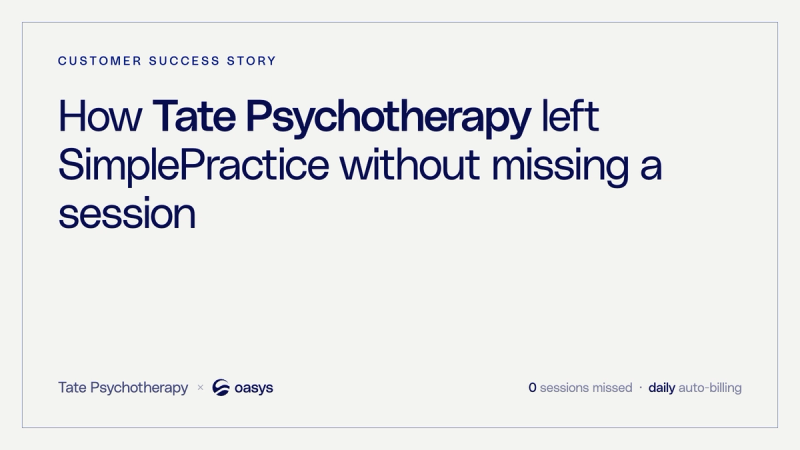
How Tate Psychotherapy left SimplePractice without missing a session
How a solo NYC psychotherapy practice switched from SimplePractice with zero missed sessions, then put notes and billing on autopilot with Oasys.
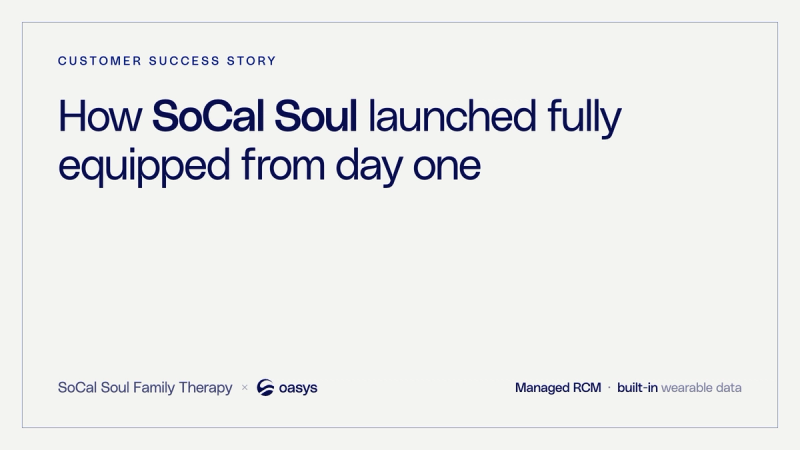
How SoCal Soul launched a fully equipped practice from day one
How a two-clinician startup launched with Oasys' Managed RCM handling all billing, and wearable health data built into the client record from day one.
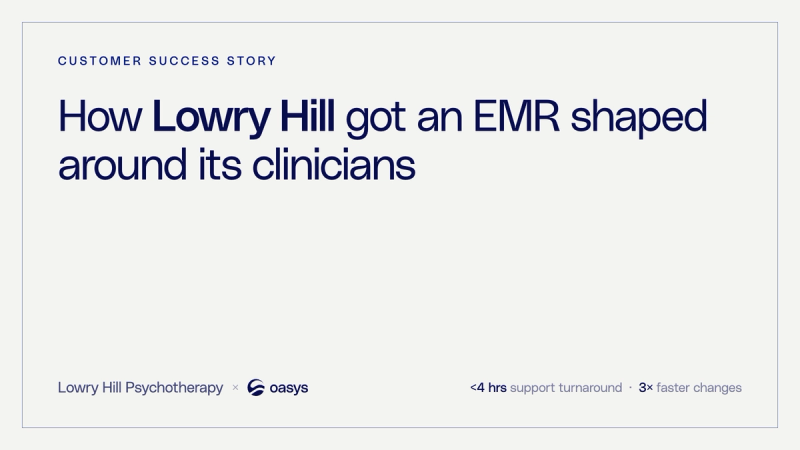
How Lowry Hill got an EMR shaped around how its clinicians actually work
How an eclectic group practice moved off TheraNest, kept billing in-house on Oasys, and got custom workflows, AI documentation, and fast support.
How Camino Nuevo cut documentation time by ~40% with Oasys
How a school-based mental health program cut documentation time ~40%, saved clinicians 8–9 hours a week, and fully onboarded in under one week.

Is it actually safe to use AI for therapy notes?
AI therapy notes can be HIPAA compliant, but safety depends on the tool, not the category. Here are three facts to verify with any vendor.

What actually goes wrong when therapy practices switch EHRs
EHR migrations fail before the data moves. Here's what actually breaks — consent gates, lost calendars, flattened notes — and how to clear it.

Own your brand vs. rent a network: the real economics
Therapy networks take 20–30% of billing revenue, per session, indefinitely. Here's how to decide when to rent a network and when to own your brand.
The group-practice scaling wall: what breaks at 5, 15, and 30 clinicians
Solo-built EHRs break at predictable thresholds. Here's what fails at 5, 15, and 30 clinicians — and the architecture gaps behind it.

Documentation burden in behavioral health: the hidden cost of manual notes
Manual therapy notes cost clinicians 6–8 unbillable hours every week. Here's what documentation burden actually costs your practice.