Documentation burden in behavioral health: the hidden cost of manual notes
The hours you never bill for, and what they cost
 Hashem Abdou5 min read
Key takeaways
- A full caseload of 25 sessions generates 6–8 hours of unbillable after-hours documentation weekly
- Unsigned note backlogs are operations risks — one practice needed a full month to clear theirs before migrating
- Generic AI transcription and modality-aware note generation are fundamentally different products
- Solo practitioners feel documentation overhead as acutely as large practices
- Oasys ties billing to signed notes, structurally preventing documentation debt from accumulating
The hidden cost of manual therapy notes is not the software you are not buying. It is the 6 to 8 hours of unbillable, after-hours documentation a full-caseload clinician already pays for every week, plus the revenue that leaks when that pressure causes notes to be rushed, deferred, or left unsigned.
Why this question matters now
Documentation is the largest cost in a behavioral health practice that no one writes a check for. It shows up as time, not as a line item, which is exactly why it stays invisible until it compounds into burnout, billing holds, or a migration that cannot start.
This draws on Oasys's proprietary knowledge: direct, ongoing conversations with practicing therapists and practice owners, plus our seat at the infrastructure layer of real practices, where we see how documentation, billing, and consent actually work day to day. Across those conversations, documentation overhead surfaces as a constant undercurrent. Not a single dramatic complaint, but a steady cost that compounds across every working day. One practice owner with three locations put it in explicitly existential terms: "the amount of time that goes into all of that is such a time suck for group practice owners."
The distinction this piece turns on: the burden is the manual workflow, not documentation itself. Notes are a clinical asset. The cost comes from how they are produced. One organization that adopted AI notes reported a per-session workflow of roughly 10 seconds of AI generation plus 5 minutes of clinician review, against a manual alternative that most clinicians in our calls described as 15 to 20 minutes per session.
Below we walk through five myths about documentation burden, answer each directly, then distill the properties that separate documentation that costs you from documentation that pays you back.
Myth: documentation is a small part of a therapist's job
For a full caseload, documentation is typically the second-largest time commitment after direct client contact. Clinicians in our conversations describe 15 to 20 minutes per session on notes when documenting manually, so a 25-session week is 6 to 8 hours of documentation.
That time is not billable. It comes after sessions end, often at home, and it accumulates into the after-hours load practitioners cite when they describe burnout. A conference panelist named the dynamic plainly: "The administrative work you have to measure... Are we asking too much? It takes the joy out of it. It's not what we're there for."
The visible cost is the hours. The less visible cost is quality degradation: the fifth note of the evening is not as good as the first.
Myth: unsigned notes are a compliance problem, not an operations problem
Unsigned notes are both. From a compliance standpoint, notes not signed within the required window create audit risk and documentation a payer can deny. From an operations standpoint, they are a deferred liability that grows.
One practice described an outstanding note backlog so significant it required an estimated full month of work to clear before a planned EHR migration could even begin. The documentation debt was the gating item. The migration could not start until it was resolved.
This is where workflow design matters. Other platforms may be built differently. Oasys ties billing to signed documentation, so payment is blocked until notes are complete. That is not a punitive feature. It is the structural incentive that prevents documentation debt from accumulating in the first place.
Myth: AI notes just transcribe what happens in the session
Generic transcription and modality-aware note generation are different products. A system that produces a narrative summary of what was said gives a clinician something to edit. A system that knows the treatment modality generates a note that is clinically accurate to the work being done.
The difference is concrete: DBT diary card structure, CBT thought record format, ACT-informed language. Other tools vary in how they handle this. Oasys generates notes that reflect the modality, not just the conversation, which is why review can land near the 5-minute figure rather than the 15 minutes of rewriting a raw transcript requires.
The distinction matters financially. A note a clinician can sign with minimal editing is a different tool than one that demands a second drafting pass.
Myth: documentation burden only affects large practices
Solo practitioners feel documentation overhead as acutely as group practices. They simply have no one to distribute it to. A solo clinician doing 25 sessions a week at 20 minutes per note is spending the equivalent of a full working day every week on documentation.
The compounding effect changes shape at scale. In group practices, documentation debt becomes visible as an operations risk: unsigned notes, billing holds, biller turnover. The per-session time cost is the same regardless of practice size.
Scale can also multiply the record count itself. One 80-clinician, 7-state practice flagged that their EHR required a separate note for each individual member of a group session, so a group of 20 or more participants generates 20 or more separate documentation records per session hour. Volume that size makes the per-note minutes a structural, not incidental, cost.
Myth: better documentation tools make notes longer and more burdensome
The practices that have adopted AI-assisted documentation describe the opposite: notes that are faster to produce and better as clinical records. One practice's AI documentation was described as "consistently impressive" in quality, not a first draft requiring heavy editing but a note accurate enough to be clinically useful at the next appointment.
The gains compound at both ends of the visit. Other platforms may be built differently. Oasys also surfaces a prep note before the session, pulling relevant chart history, prior session context, and where available wearable data, so the clinician spends less time reconstructing context manually.
Faster generation, faster review, less prep overhead. The workflow gets shorter on both sides of the session, not longer.
So, what is documentation actually costing you?
Reframe the question. It is not "should I pay for AI notes?" It is "what is my practice already paying for manual documentation?" Use these checkable properties.
- Time per session. 15 to 20 minutes manual, against roughly 10 seconds of generation plus 5 minutes of review in an AI-assisted workflow. Multiply by your weekly session count.
- After-hours load. A 25-session week at 20 minutes per note is 6 to 8 unbillable hours, much of it at home. That is the burnout surface.
- Documentation debt. Count your unsigned and incomplete notes today. That number is a deferred liability and, eventually, a migration blocker.
- Clinical usefulness. Can the note be read at the next session to recover context, or is it a transcript? A modality-aware note is an asset; a summary is a chore.
- Payer leverage. Structured, signed, complete notes are what survive an audit and what a billing process can act on without rework.
If documentation is fast to produce, high enough quality to be clinically useful next session, and structured well enough to support billing, it stops being a cost center and becomes leverage.
Frequently asked questions
- How much time do therapists spend on documentation?
Clinicians in our conversations describe 15 to 20 minutes per session on notes when documenting manually. For a 25-session week, that is 6 to 8 hours of largely unbillable, often after-hours documentation. AI-assisted workflows in our calls report roughly 10 seconds of generation plus 5 minutes of review per session.
- What is documentation burden in behavioral health?
Documentation burden is the total time, attention, and operational risk required to produce, sign, and maintain clinical notes. For a full caseload it is typically the second-largest time commitment after direct client contact, and most of it is unpaid. It compounds into after-hours load, unsigned-note backlogs, and billing holds.
- How do unsigned notes affect a therapy practice?
Unsigned notes create both compliance risk (audit exposure and payer denials) and operational risk (a growing deferred liability). One practice's backlog required an estimated full month of work to clear before an EHR migration could begin. Tying billing to signed notes, as Oasys does, prevents that debt from accumulating in the first place (other platforms may be built differently).
- How can AI reduce therapy note writing time?
Modality-aware generation produces a note that reflects the actual clinical work, not just a transcript, so review takes minutes instead of a full rewrite. In our conversations, an AI-assisted workflow ran around 10 seconds of generation plus 5 minutes of review, versus 15 to 20 minutes manual. A prep note that surfaces prior context also cuts the time spent reconstructing the chart before each session.
- What is the hidden cost of manual therapy notes?
The hidden cost is not the software you skip buying. It is the 6 to 8 unbillable hours per week a full-caseload clinician already spends, plus the quality that degrades when notes are rushed and the revenue that leaks when documentation is deferred or denied. Manual documentation is a structural financial and clinical risk, not just an inconvenience.
Documentation is not a compliance chore you pay for. It is an asset you are already paying for, the only question is whether you get anything back.
Related articles
Our Clinicians Are Burning Out on Documentation: What Actually Fixes It
Documentation burnout is not solved by writing faster. It is solved by closing the gap between the session and the note, and the backlog that gap creates.

SOAP Notes vs DAP Notes: Which Should You Use?
DAP is SOAP with the Subjective and Objective sections merged into one. The real question is which format fits how you think through a session.
How Does Wearable Data Help Clinicians Track Treatment Progress Between Sessions?
Most of what a clinician knows about a client's week comes from memory, reconstructed at the next session. Wearable data replaces that reconstruction with a pattern.
Which Behavioral Health EHRs Integrate With Wearables?
Ask most behavioral health EHRs whether they integrate with wearables and the honest answer is no. Here is what real integration looks like where it exists.

Best Billing Software for Behavioral Health Practices (2026)
The best billing software for a behavioral health practice is judged by what happens after a claim is submitted, not before. A guide to eligibility, denials, and real cost.
Should a Group Practice Buy a Standalone AI Scribe or an EHR With AI Built In?
A standalone scribe adds a second vendor touching every session. An EHR with AI built in keeps the note, the chart, and the claim in one system.
How Group Therapy Practices Reduce Insurance Claim Denials
Most denials are not random payer behavior. They trace back to a handful of preventable causes, and each one has a specific, checkable fix.
Best Practice Management Software for Therapists (2026)
The best practice management software for therapists depends on clinician count, not features on a marketing page. A guide to what actually separates the options at each stage.
Can AI Write Therapy Notes That Hold Up to an Insurance Audit?
An auditor does not check whether AI wrote a note. They check whether a clinician actually reviewed it, signed it, and whether it supports the billed code.
Does Your EHR Track Supervision Hours Toward Licensure?
No. Your EHR almost certainly does not accumulate supervision hours toward a licensing board, and Oasys does not either.
HIPAA Compliant Therapy Platform: What to Actually Verify (2026)
"HIPAA compliant" is not a certification a vendor earns once. It is a signed BAA plus specific, checkable safeguards. Here is what to actually verify before you sign.
Superbills for Therapists: What They Are and When to Use One
A superbill is an itemized receipt a client submits to their own insurer for reimbursement. Here is what has to be on one, and when a practice needs them at all.
Individual Therapy Billing: CPT 90837, 90834, and 90832 Explained
CPT 90837 covers individual psychotherapy of 53 minutes or more. Here is how it differs from 90834 and 90832, and why 90837 draws more payer scrutiny than either.
TheraNest vs SimplePractice: Which Is Better for Your Practice?
TheraNest prices on active clients rather than seats, which suits fluctuating caseloads. Plus a migration warning worth reading before you commit.
How IM+CANS batch export works, and why double entry isn't required
Getting a completed IM+CANS assessment into Illinois HFS's provider portal does not have to mean retyping the same client's data a second time.
Best EHR for IM+CANS (IMCANS) in Illinois (2026): what actually matters
The best IMCANS EHR is not the one with an IM+CANS-shaped form. It is the one that treats IM+CANS as five separate problems stacked together: the roughly 700-field instrument…
What IM+CANS (IMCANS) actually requires from an Illinois practice
IM+CANS is not optional paperwork. It is the single instrument the Illinois Department of Healthcare and Family Services (HFS) designated for Integrated Assessment and Treatment…
How to Grow a Group Therapy Practice From 5 to 25 Clinicians Without It Breaking
The practice does not break from headcount. It breaks from the workflows that were fine at 5 clinicians and were never redesigned for 15 or 25.
Credentialing vs. Payer Enrollment vs. Clearinghouse Enrollment: Why They're Not the Same
Credentialing, payer enrollment, and clearinghouse enrollment are three separate steps that happen in sequence, not one process with three names.
The Weekly KPIs a Group Therapy Practice Owner Should Actually Watch
A group therapy practice owner should watch four numbers every week: utilization, no-show rate, caseload per clinician, and billing health.

TheraPlatform vs SimplePractice: Which Suits Your Practice?
TheraPlatform was built around teletherapy rather than retrofitted for it. Whether that is worth it comes down to one number, your virtual share.
TheraNest Reviews: What Therapists Actually Say
Active-client pricing makes TheraNest cheaper for variable caseloads. Reviews are solid on function, softer on polish, and mixed on migration.
Sessions Health Reviews: What Therapists Actually Say
Reviewers consistently praise price, simplicity and support. The one consistent criticism is reporting, and whether that matters depends on your size.
Jane App Reviews: What Therapists Actually Say
Praise concentrates on scheduling and running a mixed clinic from one system. Criticism concentrates on mental health depth and treatment plans.
Sessions Health vs SimplePractice: A Practical Comparison
Sessions Health is the better value for small practices, with free admin seats and no feature gating. The trade-off is reporting depth.

Jane App vs SimplePractice: Which Fits a Therapy Practice?
Jane wins on scheduling and multi-disciplinary clinics. SimplePractice wins on therapy-specific depth. The treatment-plan gap decides most of it.
Oasys vs TherapyNotes: Which Is Better for a Group Practice?
TherapyNotes is genuinely well built. Here is where it stops fitting a growing group practice, and what the per-transaction fees really add up to.
Oasys vs SimplePractice: Which Is Better for a Group Practice?
A straight comparison for practices with five or more clinicians, covering supervision, permissions, payroll and what switching actually involves.
SimplePractice Reviews: What Practices Actually Say in 2026
SimplePractice is excellent for solo therapists and strains for group practices. What practices praise, what they criticise, and where the line falls.
SimplePractice vs TherapyNotes: An Honest Comparison for 2026
Two good products that break in the same place. An honest comparison of pricing, supervision and billing, with our own stake clearly labelled.
SimplePractice Alternatives for Group Practices
Why group practices outgrow SimplePractice, what the realistic alternatives are, and how to move eight years of records without breaking the practice.
What SimplePractice and TherapyNotes Actually Cost a Group Practice
The subscription is the smallest part of the bill. What group practices actually pay once per-claim fees, text charges and workarounds are counted.
Best EHR for Group Therapy Practices (2026)
Group practices break in predictable places as they grow. A ranked guide organised around what fails at five, fifteen and thirty clinicians.
Mental Health EHRs: The Complete Comparison Guide (2026)
There is no best mental health EHR, only a best one for your size. A guide organised by practice size, with five tests demos are not designed for.
Mental Health EHR Requirements: What to Actually Demand
The requirements that actually matter, grouped by what breaks at five, fifteen and thirty clinicians, plus a ten-item checklist to run live in a demo.
Mental Health Treatment Plan Examples
The four parts of a usable plan, worked examples for anxiety, depression, trauma and substance use, and the goal formula that makes progress notes write themselves.
Group Therapy Billing: CPT 90853, 90847, and 90846 Explained
CPT 90853, 90847 and 90846 explained, plus the five-minute test that shows whether your EHR can actually bill a group session without manual work.
DAP Notes: Format, Examples, and When to Use Them
Data, Assessment, Plan. A worked example, how DAP compares with SOAP and BIRP, and the mistakes that make notes fail during a payer audit.
SOAP Notes: Format, Examples, and How to Write Them Faster
The four sections, a worked example with a real assessment, and why notes take so long. Hint: it is almost never the template that slows you down.
How Tate Psychotherapy left SimplePractice without missing a session
How a solo NYC psychotherapy practice switched from SimplePractice with zero missed sessions, then put notes and billing on autopilot with Oasys.
How SoCal Soul launched a fully equipped practice from day one
How a two-clinician startup launched with Oasys' Managed RCM handling all billing, and wearable health data built into the client record from day one.
How Lowry Hill got an EMR shaped around how its clinicians actually work
How an eclectic group practice moved off TheraNest, kept billing in-house on Oasys, and got custom workflows, AI documentation, and fast support.
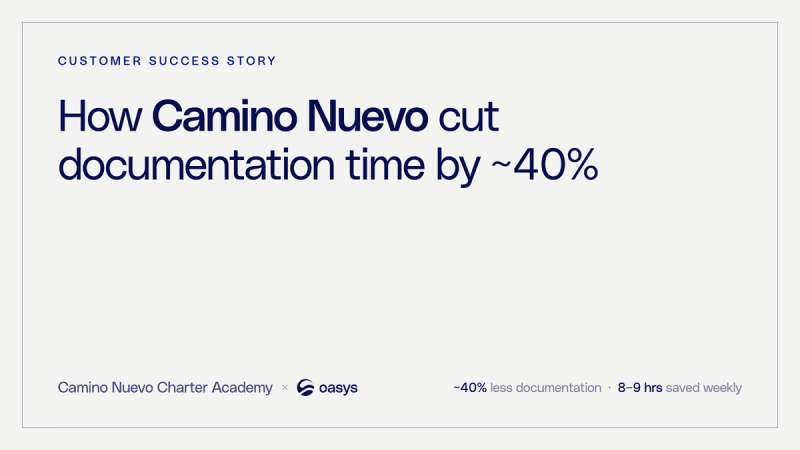
How Camino Nuevo cut documentation time by ~40% with Oasys
How a school-based mental health program cut documentation time ~40%, saved clinicians 8–9 hours a week, and fully onboarded in under one week.

Is it actually safe to use AI for therapy notes?
AI therapy notes can be HIPAA compliant, but safety depends on the tool, not the category. Here are three facts to verify with any vendor.

What actually goes wrong when therapy practices switch EHRs
EHR migrations fail before the data moves. Here's what actually breaks — consent gates, lost calendars, flattened notes — and how to clear it.

Own your brand vs. rent a network: the real economics
Therapy networks take 20–30% of billing revenue, per session, indefinitely. Here's how to decide when to rent a network and when to own your brand.
The group-practice scaling wall: what breaks at 5, 15, and 30 clinicians
Solo-built EHRs break at predictable thresholds. Here's what fails at 5, 15, and 30 clinicians — and the architecture gaps behind it.

Documentation burden in behavioral health: the hidden cost of manual notes
Manual therapy notes cost clinicians 6–8 unbillable hours every week. Here's what documentation burden actually costs your practice.