Oasys vs SimplePractice: Which Is Better for a Group Practice?
A straight comparison for practices past five clinicians
 Mohamed Badran7 min read
Key takeaways
- SimplePractice is the better product for solo and very small practices.
- Supervision that ignores credential status is the clearest functional gap.
- Payroll is not modelled, so practices rebuild it in spreadsheets each month.
- Oasys is $80 per clinician per month, annual, with no add-ons.
- Migration runs as a custom pipeline you can inspect before committing.
Short answer: For a group practice with five or more clinicians, especially one running supervisees or a training program, Oasys is the better fit, because supervision, permissions, and payroll are native rather than bolted on. For a solo therapist or a small practice that values a mature mobile app and a large ecosystem, SimplePractice is still an excellent product and we'd tell you so.
This comparison draws on our ongoing conversations with practice owners, many of them current or former SimplePractice customers.
At a glance
On pricing. SimplePractice publishes Starter at $49, Essential at $79 and Plus at $99 a month. Group practices need Plus, and additional clinicians are tiered: $74 each for 2 to 5 clinicians, $72 for 6 to 15, and $69 for 16 or more. Care Aide, Note Taker and ePrescribe are separate add-ons. Verified against both vendors' pricing pages on 30 July 2026.
Where SimplePractice is genuinely strong
We're not going to pretend this is a one-sided comparison, and the practices we talk to don't either.
SimplePractice has a mature, polished product with an enormous user base, a strong mobile experience, broad support for practitioner types beyond mental health, and an ecosystem, templates, community, documentation: that a newer platform simply doesn't have yet. For a solo therapist, it is a very good answer, and a large number of the practices we speak with were happy on it for years.
The pattern isn't that SimplePractice is bad. It's that the thing it optimizes for stops being the thing you need somewhere around your fifth or tenth clinician.
Supervision: the clearest difference
SimplePractice requires supervisor sign-off on all supervisees, regardless of credential status. That's a reasonable default for interns. It's the wrong default for a provisionally licensed clinician who is independently credentialed with your payers and does not legally require a co-signature.
One practice put the request plainly: "if it's a supervisee, you have to sign off on everything. Is there a way to differentiate that?"
Oasys approaches this differently. Supervision is configured per role and per supervisor-supervisee relationship, so clinicians who don't require a co-signature can be exempted without switching supervision off for everyone else.
For a practice with 15 supervisees, this is the difference between a supervisor spending their week reviewing clinical work and spending it clicking.
Payroll: the cost nobody puts on a comparison table
The largest number in this comparison is about neither platform's list price.
"About 20 hours a week of our billing manager goes into converting the information in [our EHR] into a payroll ledger."
Twenty hours a week (half a full-time role, permanently) because the EHR has no model for how the practice pays people. And the comp structures involved aren't unusual: a one revenue split for contractor day-rate sessions and a different one for off-hours, and for salaried clinicians a split carrying an hourly minimum plus a monthly commission.
Oasys models the revenue split natively, supports per-therapist overrides, and produces the payroll ledger as an output rather than as a monthly manual project. Payout can be gated on the underlying notes being signed and approved.
Pricing at group-practice scale
SimplePractice's model is a base plan plus a per-clinician charge, with payment processing on top, one practice flagged their card rate at roughly 3.25%, noting "that really adds up so much." And per-seat pricing doesn't distinguish credential status: "it's the same cost for a clinician versus an intern."
Oasys is $80 per clinician per month on an annual contract, with no add-ons. Billing, supervision, scheduling, documentation, and payroll reporting are included rather than tiered.
For a practice running a training program, the intern math is where this lands hardest. One practice we spoke with carries more trainees than licensed clinicians. Under flat per-seat pricing, more than half their seats are people who cannot yet bill independently.
Billing and claims
Practices report verification of benefits as "barely functional" on SimplePractice, with staff checking payer portals manually. Superbills get exported into a second tool for submission, one practice described the workflow as "pretty cumbersome." Another hit a rendering-provider bug that caused every Medicaid claim to be rejected by their payer: "every Medicaid claim now requires manual editing. Not sustainable."
That last one is worth sitting with, because it's the scenario that turns a planned migration into an emergency one.
Switching: the honest part
This is where most comparison pages hand-wave, so let's be specific.
Practices in this category are typically 8 to 11 years into their current system. The fear isn't that the new platform is worse, it's that the move itself will break the practice. That fear is well earned. A practice that attempted a migration to another platform described it as "awful. Bad. So bad." Another paid extra for white-glove onboarding and still found records "migrated over and done incorrectly," with "contradictory and incomplete answers" for months afterward.
The sentence we hear over and over, in different words: "we can't do it twice."
Migration is the question we are asked about most. Rather than make promises in a blog post, ask us directly what moving your particular system would involve, what comes across, and what happens to appointments already booked.
Who should choose which
Choose SimplePractice if you're solo or a small practice, you want a mature mobile app, you work across practitioner types beyond mental health, or you value a large established ecosystem and community.
Choose Oasys if you have five or more clinicians, you supervise interns or provisionally licensed clinicians, you're rebuilding payroll in a spreadsheet every month, you need role-based permissions, or you want per-clinician pricing without add-on tiers.
Frequently asked questions
- Is Oasys better than SimplePractice for group practices?
For practices with five or more clinicians, yes, specifically on supervision, role-based permissions, and native payroll reporting. For solo practitioners, SimplePractice remains an excellent choice.
- What are the cons of SimplePractice?
For group practices: supervision that doesn't distinguish credential status, per-seat pricing that charges full rate for interns, couples and family records that don't link, manual billing workflows at volume, and no API.
- How much does SimplePractice cost for a 10-person group practice?
Base plan plus per-clinician charges plus payment processing. Check their current pricing page for list rates, then add your card-processing spread and any add-ons, practices consistently report the total running well above the headline number.
- Does SimplePractice have an API?
No. Practices that want to connect analytics, ad attribution, or BI tooling can't.
- Will my clinicians have to relearn everything?
Some, unavoidably. Change fatigue is a real cost that practices raise with us directly, and phased rollouts (moving one workflow first and the full record later) are a legitimate way to manage it.
Related articles
How IM+CANS batch export works, and why double entry isn't required
Getting a completed IM+CANS assessment into Illinois HFS's provider portal does not have to mean retyping the same client's data a second time.

Best EHR for IM+CANS (IMCANS) in Illinois (2026): what actually matters
The best IMCANS EHR is not the one with an IM+CANS-shaped form. It is the one that treats IM+CANS as five separate problems stacked together: the roughly 700-field instrument…

What IM+CANS (IMCANS) actually requires from an Illinois practice
IM+CANS is not optional paperwork. It is the single instrument the Illinois Department of Healthcare and Family Services (HFS) designated for Integrated Assessment and Treatment…

The Weekly KPIs a Group Therapy Practice Owner Should Actually Watch
A group therapy practice owner should watch four numbers every week: utilization (booked hours against available hours), no-show and cancellation rate, caseload per clinician…
How to Grow a Group Therapy Practice From 5 to 25 Clinicians Without It Breaking
The practice does not break from headcount. It breaks from the workflows that were fine at 5 clinicians and were never redesigned for 15 or 25.

Credentialing vs. Payer Enrollment vs. Clearinghouse Enrollment: Why They're Not the Same
Credentialing, payer enrollment, and clearinghouse enrollment are three separate steps that happen in sequence, not one process with three names.
TheraPlatform Reviews: What Therapists Actually Say
Reviews split cleanly on one line: how much of your practice happens on video. Above seventy percent virtual, the session tooling earns its place.

TheraNest Reviews: What Therapists Actually Say
Active-client pricing makes TheraNest cheaper for variable caseloads. Reviews are solid on function, softer on polish, and mixed on migration.
Sessions Health Reviews: What Therapists Actually Say
Reviewers consistently praise price, simplicity and support. The one consistent criticism is reporting, and whether that matters depends on your size.

Jane App Reviews: What Therapists Actually Say
Praise concentrates on scheduling and running a mixed clinic from one system. Criticism concentrates on mental health depth and treatment plans.

TheraPlatform vs SimplePractice: Which Suits Your Practice?
TheraPlatform was built around teletherapy rather than retrofitted for it. Whether that is worth it comes down to one number: your virtual share.

TheraNest vs SimplePractice: Which Is Better for Your Practice?
TheraNest prices on active clients rather than seats, which suits fluctuating caseloads. Plus a migration warning worth reading before you commit.

Sessions Health vs SimplePractice: A Practical Comparison
Sessions Health is the better value for small practices, with free admin seats and no feature gating. The trade-off is reporting depth.

Jane App vs SimplePractice: Which Fits a Therapy Practice?
Jane wins on scheduling and multi-disciplinary clinics. SimplePractice wins on therapy-specific depth. The treatment-plan gap decides most of it.

Oasys vs TherapyNotes: Which Is Better for a Group Practice?
TherapyNotes is genuinely well built. Here is where it stops fitting a growing group practice, and what the per-transaction fees really add up to.

Oasys vs SimplePractice: Which Is Better for a Group Practice?
A straight comparison for practices with five or more clinicians, covering supervision, permissions, payroll and what switching actually involves.
SimplePractice Reviews: What Practices Actually Say in 2026
SimplePractice is excellent for solo therapists and strains for group practices. What practices praise, what they criticise, and where the line falls.

SimplePractice vs TherapyNotes: An Honest Comparison for 2026
Two good products that break in the same place. An honest comparison of pricing, supervision and billing, with our own stake clearly labelled.

SimplePractice Alternatives for Group Practices
Why group practices outgrow SimplePractice, what the realistic alternatives are, and how to move eight years of records without breaking the practice.

What SimplePractice and TherapyNotes Actually Cost a Group Practice
The subscription is the smallest part of the bill. What group practices actually pay once per-claim fees, text charges and workarounds are counted.
Best EHR for Group Therapy Practices (2026)
Group practices break in predictable places as they grow. A ranked guide organised around what fails at five, fifteen and thirty clinicians.
Mental Health EHRs: The Complete Comparison Guide (2026)
There is no best mental health EHR, only a best one for your size. A guide organised by practice size, with five tests demos are not designed for.
Mental Health EHR Requirements: What to Actually Demand
The requirements that actually matter, grouped by what breaks at five, fifteen and thirty clinicians, plus a ten-item checklist to run live in a demo.
Mental Health Treatment Plan Examples
The four parts of a usable plan, worked examples for anxiety, depression, trauma and substance use, and the goal formula that makes progress notes write themselves.
Group Therapy Billing: CPT 90853, 90847, and 90846 Explained
CPT 90853, 90847 and 90846 explained, plus the five-minute test that shows whether your EHR can actually bill a group session without manual work.

DAP Notes: Format, Examples, and When to Use Them
Data, Assessment, Plan. A worked example, how DAP compares with SOAP and BIRP, and the mistakes that make notes fail during a payer audit.

SOAP Notes: Format, Examples, and How to Write Them Faster
The four sections, a worked example with a real assessment, and why notes take so long. Hint: it is almost never the template that slows you down.
How Tate Psychotherapy left SimplePractice without missing a session
How a solo NYC psychotherapy practice switched from SimplePractice with zero missed sessions, then put notes and billing on autopilot with Oasys.
How SoCal Soul launched a fully equipped practice from day one
How a two-clinician startup launched with Oasys' Managed RCM handling all billing, and wearable health data built into the client record from day one.

How Lowry Hill got an EMR shaped around how its clinicians actually work
How an eclectic group practice moved off TheraNest, kept billing in-house on Oasys, and got custom workflows, AI documentation, and fast support.
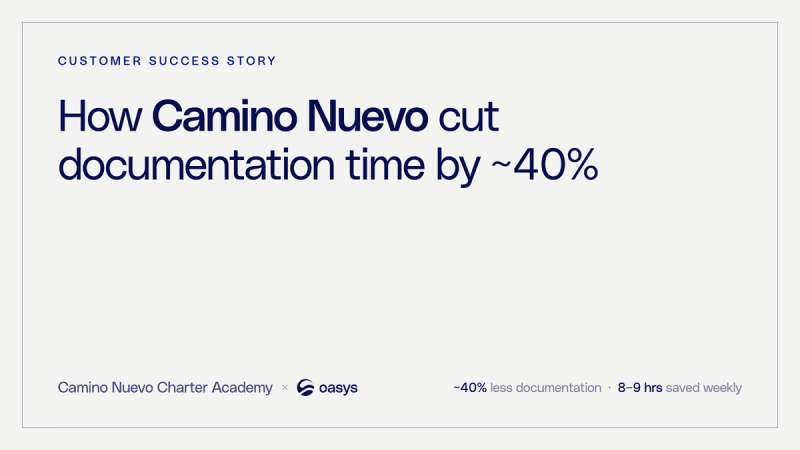
How Camino Nuevo cut documentation time by ~40% with Oasys
How a school-based mental health program cut documentation time ~40%, saved clinicians 8–9 hours a week, and fully onboarded in under one week.

Is it actually safe to use AI for therapy notes?
AI therapy notes can be HIPAA compliant, but safety depends on the tool, not the category. Here are three facts to verify with any vendor.

What actually goes wrong when therapy practices switch EHRs
EHR migrations fail before the data moves. Here's what actually breaks — consent gates, lost calendars, flattened notes — and how to clear it.

Own your brand vs. rent a network: the real economics
Therapy networks take 20–30% of billing revenue, per session, indefinitely. Here's how to decide when to rent a network and when to own your brand.
The group-practice scaling wall: what breaks at 5, 15, and 30 clinicians
Solo-built EHRs break at predictable thresholds. Here's what fails at 5, 15, and 30 clinicians — and the architecture gaps behind it.

Documentation burden in behavioral health: the hidden cost of manual notes
Manual therapy notes cost clinicians 6–8 unbillable hours every week. Here's what documentation burden actually costs your practice.