Mental Health EHR Requirements: What to Actually Demand
Grouped by what breaks as you grow
 Hashem Abdou7 min read
Key takeaways
- Non-negotiable: BAA covering subprocessors, audit logs, change history, role-based access.
- Permissions break around five clinicians, supervision and payroll around fifteen.
- Ask for a payroll ledger as an output, not a report you rebuild.
- Test group billing live: one session, eight attendees, count the actions.
- Make vendors perform the ten-item checklist rather than describe features.
Short answer: The requirements that matter divide into three tiers. Non-negotiable: a signed BAA, audit logging, role-based access, and a full change history on amended notes. Size-dependent: supervision configuration, permissions granularity, payroll reporting, and group billing, all of which start mattering somewhere around five clinicians. Nice to have: everything a demo spends its time on.
Most requirements checklists are feature lists. This one is organised by what actually breaks, because Oasys sits at the infrastructure layer of working practices and from our ongoing conversations with therapists and group practice owners, the same four things fail in the same order as a practice grows.
Tier 1: non-negotiable, whatever your size
A signed BAA that covers subprocessors. Not just the EHR. If the platform uses a third-party AI service, a transcription vendor, or an analytics provider that touches PHI, ask whether the BAA extends to them. A BAA covering the EHR does not automatically cover a subprocessor.
Audit logging you can actually retrieve. Not "we log everything." Ask to see an export. During an investigation you need to answer who viewed a record and when, in a format you can hand over.
A full change history on amended notes. If a signed note is later unlocked and edited, the record should show who unlocked it, the stated reason, the content before and after, and when it was re-signed. Practices tell us some platforms do not produce this, and it is a genuine exposure during a payer audit. Oasys keeps all four. Other platforms vary, so ask directly and ask to see it demonstrated.
Role-based access. Your biller should not see clinical notes they have no reason to read. Once you have any non-clinical staff, all-or-nothing admin access stops being defensible.
Data export on your terms. Ask how you would get everything out in three years, and what "everything" includes. The answer tells you how the vendor thinks about lock-in.
Tier 2: the requirements that appear as you grow
These are the ones buyers under-specify, because at the point of purchase they are not yet painful.
Around five clinicians: permissions
The moment you employ an office manager, a biller, and clinicians who should not see each other's caseloads, coarse permissions start creating either risk or friction. This is also where couples and family work begins producing duplicate records if the platform cannot link them. One practice described a client completing intake individually, then needing a couples appointment: "we couldn't link them. And so they had to redo all the paperwork."
Demand: distinct roles with scoped access, and linked records for couples and family work.
Around fifteen clinicians: supervision and payroll
Supervision. Ask how supervision requirements are set. Many platforms require supervisor sign-off on every supervisee identically, including provisionally licensed clinicians who are independently credentialed with payers and do not legally require a co-signature. At three supervisees that is a nuisance. At fifteen it consumes a supervisor's week. Oasys configures supervision per role and per supervisor-supervisee relationship, so clinicians who do not need a co-signature can be exempted without switching supervision off across the practice. Other platforms handle this differently.
Payroll. This is the requirement almost nobody writes down and everybody eventually needs. One practice with a couple of dozen clinicians told us about twenty hours a week of a billing manager's time going into converting EHR data into a payroll ledger, because the software had no way to express how the practice pays people. That is half a full-time role, permanently, and it appears on no invoice.
Demand: a payroll ledger as an output, not a report you rebuild. Ask specifically whether revenue splits can vary per clinician, and whether payout can be gated on the underlying notes being signed and approved.
Around thirty clinicians: economics and observability
Per-user pricing with no volume consideration becomes the dominant line item. One practice put it plainly: "there's a point where it's going to get too expensive, because it's a cost per user." Per-transaction fees on claims, ERAs and text reminders compound exactly as you succeed.
Demand: predictable pricing you can model at double your current headcount, and practice-level reporting on revenue, retention, and utilisation without buying a second tool. One practice pays $300 to $400 a month for external analytics because their EHR does not provide them.
Group billing: the requirement with a five-minute test
If you run groups, this deserves its own line. CPT 90853 is billed per participant, so one group of eight is eight claims, each under that person's own name, insurance and authorisation.
The test: ask the vendor, live in the demo, to create one group session with eight attendees and produce eight correct claims. Count the actions. Then give two attendees different payers and a third an expired authorisation and watch what happens.
Platforms built around one clinician and one client can record a group but have no concept of fanning one clinical event into eight billable ones, so a human does it eight times.
Tier 3: what demos spend their time on
Mobile app polish, template libraries, client portal design, telehealth backgrounds. All genuinely nice. None of them is why practices leave. Weight them accordingly.
The requirements checklist
Take this into a demo and make them show you, not tell you:
- BAA covering subprocessors, in writing
- An audit log export, on screen
- An amended signed note with its full change history
- Two roles configured with genuinely different access
- A couples record linked across two clients
- Supervision configured so one clinician requires co-sign and another does not
- Eight claims produced from one group session
- A payroll ledger generated from real session data
- Practice-level reporting on revenue and retention
- A written answer on how you export everything in three years
Any vendor can pass a feature checklist. Fewer can pass this one in front of you.
A requirement most checklists miss
How you get in matters as much as what happens once you are there. Group practices in this category typically carry eight to eleven years of records, and failed migrations are common enough that the fear is rational. Practices tell us the same sentence in different words: we cannot do it twice.
Ask any vendor: will you build a migration path for my system, or hand me an importer? Does it carry completed assessments and intake forms, not just notes and demographics? What happens to appointments already on the calendar? Can I see the migrated data before I sign? Who does the work, your team or mine?
Those five questions separate vendors faster than any feature comparison.
Frequently asked questions
- What should I look for in a mental health EHR?
Start with the non-negotiables: a BAA covering subprocessors, retrievable audit logs, a full change history on amended notes, role-based access, and a clear data export path. Then add the size-dependent requirements: supervision configuration, permissions, payroll reporting and group billing.
- What are the HIPAA requirements for an EHR?
At minimum a signed Business Associate Agreement, access controls, audit controls, integrity controls, and transmission security. Ask specifically whether the BAA extends to any subprocessors handling PHI, including AI and transcription vendors.
- Does a mental health EHR need to be ONC certified?
Not for most outpatient therapy practices. It matters if you participate in programmes requiring certified technology, or if certification is a condition of a payer or health system relationship. Confirm against your own contracts rather than assuming.
- What EHR features do group practices need that solo practices do not?
Configurable supervision, role-based permissions, linked couples and family records, payroll reporting, and group billing that produces one claim per participant from a single session.
- How do I evaluate an EHR demo?
Make the vendor perform tasks rather than describe features. The ten-item checklist above is designed for exactly that, and the group-session and payroll tests are the two that most reliably separate platforms.
- What questions should I ask about data migration?
Whether they build a path for your specific system, what record types come across (assessments and intake forms are the usual casualties), what happens to future appointments, whether you can inspect the migrated data before committing, and who does the work.
Related articles
How IM+CANS batch export works, and why double entry isn't required
Getting a completed IM+CANS assessment into Illinois HFS's provider portal does not have to mean retyping the same client's data a second time.

Best EHR for IM+CANS (IMCANS) in Illinois (2026): what actually matters
The best IMCANS EHR is not the one with an IM+CANS-shaped form. It is the one that treats IM+CANS as five separate problems stacked together: the roughly 700-field instrument…

What IM+CANS (IMCANS) actually requires from an Illinois practice
IM+CANS is not optional paperwork. It is the single instrument the Illinois Department of Healthcare and Family Services (HFS) designated for Integrated Assessment and Treatment…
The Weekly KPIs a Group Therapy Practice Owner Should Actually Watch
A group therapy practice owner should watch four numbers every week: utilization (booked hours against available hours), no-show and cancellation rate, caseload per clinician…
How to Grow a Group Therapy Practice From 5 to 25 Clinicians Without It Breaking
The practice does not break from headcount. It breaks from the workflows that were fine at 5 clinicians and were never redesigned for 15 or 25.

Credentialing vs. Payer Enrollment vs. Clearinghouse Enrollment: Why They're Not the Same
Credentialing, payer enrollment, and clearinghouse enrollment are three separate steps that happen in sequence, not one process with three names.
TheraPlatform Reviews: What Therapists Actually Say
Reviews split cleanly on one line: how much of your practice happens on video. Above seventy percent virtual, the session tooling earns its place.

TheraNest Reviews: What Therapists Actually Say
Active-client pricing makes TheraNest cheaper for variable caseloads. Reviews are solid on function, softer on polish, and mixed on migration.

Sessions Health Reviews: What Therapists Actually Say
Reviewers consistently praise price, simplicity and support. The one consistent criticism is reporting, and whether that matters depends on your size.

Jane App Reviews: What Therapists Actually Say
Praise concentrates on scheduling and running a mixed clinic from one system. Criticism concentrates on mental health depth and treatment plans.

TheraPlatform vs SimplePractice: Which Suits Your Practice?
TheraPlatform was built around teletherapy rather than retrofitted for it. Whether that is worth it comes down to one number: your virtual share.

TheraNest vs SimplePractice: Which Is Better for Your Practice?
TheraNest prices on active clients rather than seats, which suits fluctuating caseloads. Plus a migration warning worth reading before you commit.

Sessions Health vs SimplePractice: A Practical Comparison
Sessions Health is the better value for small practices, with free admin seats and no feature gating. The trade-off is reporting depth.

Jane App vs SimplePractice: Which Fits a Therapy Practice?
Jane wins on scheduling and multi-disciplinary clinics. SimplePractice wins on therapy-specific depth. The treatment-plan gap decides most of it.

Oasys vs TherapyNotes: Which Is Better for a Group Practice?
TherapyNotes is genuinely well built. Here is where it stops fitting a growing group practice, and what the per-transaction fees really add up to.

Oasys vs SimplePractice: Which Is Better for a Group Practice?
A straight comparison for practices with five or more clinicians, covering supervision, permissions, payroll and what switching actually involves.
SimplePractice Reviews: What Practices Actually Say in 2026
SimplePractice is excellent for solo therapists and strains for group practices. What practices praise, what they criticise, and where the line falls.

SimplePractice vs TherapyNotes: An Honest Comparison for 2026
Two good products that break in the same place. An honest comparison of pricing, supervision and billing, with our own stake clearly labelled.

SimplePractice Alternatives for Group Practices
Why group practices outgrow SimplePractice, what the realistic alternatives are, and how to move eight years of records without breaking the practice.
What SimplePractice and TherapyNotes Actually Cost a Group Practice
The subscription is the smallest part of the bill. What group practices actually pay once per-claim fees, text charges and workarounds are counted.
Best EHR for Group Therapy Practices (2026)
Group practices break in predictable places as they grow. A ranked guide organised around what fails at five, fifteen and thirty clinicians.
Mental Health EHRs: The Complete Comparison Guide (2026)
There is no best mental health EHR, only a best one for your size. A guide organised by practice size, with five tests demos are not designed for.
Mental Health EHR Requirements: What to Actually Demand
The requirements that actually matter, grouped by what breaks at five, fifteen and thirty clinicians, plus a ten-item checklist to run live in a demo.
Mental Health Treatment Plan Examples
The four parts of a usable plan, worked examples for anxiety, depression, trauma and substance use, and the goal formula that makes progress notes write themselves.
Group Therapy Billing: CPT 90853, 90847, and 90846 Explained
CPT 90853, 90847 and 90846 explained, plus the five-minute test that shows whether your EHR can actually bill a group session without manual work.

DAP Notes: Format, Examples, and When to Use Them
Data, Assessment, Plan. A worked example, how DAP compares with SOAP and BIRP, and the mistakes that make notes fail during a payer audit.

SOAP Notes: Format, Examples, and How to Write Them Faster
The four sections, a worked example with a real assessment, and why notes take so long. Hint: it is almost never the template that slows you down.
How Tate Psychotherapy left SimplePractice without missing a session
How a solo NYC psychotherapy practice switched from SimplePractice with zero missed sessions, then put notes and billing on autopilot with Oasys.
How SoCal Soul launched a fully equipped practice from day one
How a two-clinician startup launched with Oasys' Managed RCM handling all billing, and wearable health data built into the client record from day one.

How Lowry Hill got an EMR shaped around how its clinicians actually work
How an eclectic group practice moved off TheraNest, kept billing in-house on Oasys, and got custom workflows, AI documentation, and fast support.
How Camino Nuevo cut documentation time by ~40% with Oasys
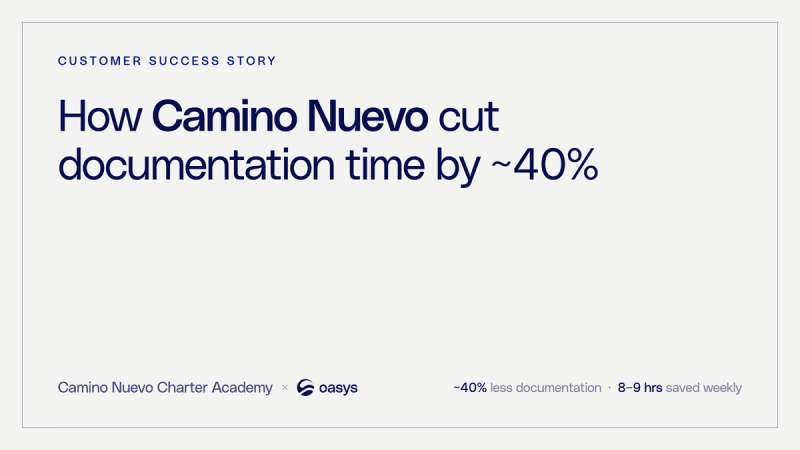
How a school-based mental health program cut documentation time ~40%, saved clinicians 8–9 hours a week, and fully onboarded in under one week.

Is it actually safe to use AI for therapy notes?
AI therapy notes can be HIPAA compliant, but safety depends on the tool, not the category. Here are three facts to verify with any vendor.

What actually goes wrong when therapy practices switch EHRs
EHR migrations fail before the data moves. Here's what actually breaks — consent gates, lost calendars, flattened notes — and how to clear it.

Own your brand vs. rent a network: the real economics
Therapy networks take 20–30% of billing revenue, per session, indefinitely. Here's how to decide when to rent a network and when to own your brand.
The group-practice scaling wall: what breaks at 5, 15, and 30 clinicians
Solo-built EHRs break at predictable thresholds. Here's what fails at 5, 15, and 30 clinicians — and the architecture gaps behind it.

Documentation burden in behavioral health: the hidden cost of manual notes
Manual therapy notes cost clinicians 6–8 unbillable hours every week. Here's what documentation burden actually costs your practice.