The group-practice scaling wall: what breaks at 5, 15, and 30 clinicians
Why solo-built systems give out at predictable sizes
 Hashem Abdou6 min read
Key takeaways
- Solo-built EHRs lack the permission tiers and supervision logic group practices need
- Co-sign workflows must distinguish credential status, not just toggle on or off
- Shared clients require deliberate chart architecture — duplicate profiles break continuity
- Billing complexity stacks at 15+ clinicians, creating revenue leakage risk
- Coarse permissions create real HIPAA exposure around 30 clinicians
The best EHR for a group therapy practice is one built for multiple permission tiers, supervision logic that distinguishes credential status, and shared-chart access from the start. The platform that worked at solo scale rarely qualifies, because the gaps that break at headcount are invisible at one clinician.
Why the scaling wall is real
Group practices do not fail at scale because clinicians get worse. They fail because the EHR underneath them was designed for one person, and the cost of that design only becomes visible as you add people.
This post draws on Oasys's proprietary knowledge: direct, ongoing conversations with practicing therapists and practice owners, and our seat at the infrastructure layer of real practices, where we see how documentation, billing, and consent actually work day to day. Across those conversations, EHR limitations surface at predictable thresholds. One practice running 60 to 70 insurance claims per day across 17 therapists described modifier management as very time-consuming: a manual step that compounds with every clinician added. Another described their biller leaving and a care coordinator going on maternity leave as an existential threat, driven directly by the manual overhead their EHR creates.
The distinction this piece turns on is simple: the risk is not the technology, it is the tool. A solo-built EHR is not a smaller version of a group EHR. It is a different architecture, missing the permission tiers, supervision logic, and shared-chart structure that group work requires.
Below are five signs your practice has outgrown a solo-built EHR, organized by the thresholds where they bite: 5, 15, and 30 clinicians.
Does the EHR that worked at solo scale keep working as you add clinicians?
Usually not. Most EHRs designed for solo practitioners share a single permission tier, a single billing queue, and no supervision architecture, and those gaps are invisible at one clinician.
At five, the absence of co-signing workflows, shared client access, and per-role permissions starts creating real problems. The practices that describe this most clearly are the ones that grew faster than they expected to. They did not choose the wrong tool. They chose the right tool for a practice they no longer are.
The threshold. Solo-built EHRs break first around clinician five, when one queue and one permission level can no longer model who should see and do what.
How do supervisors sign off on associate notes?
A supervisor co-signs a note to take clinical and legal responsibility for work done by a provisionally licensed clinician. The architecture that makes this safe has to distinguish credential status, not just toggle co-sign on or off.
Supervision logic in most EHRs is binary: either a clinician requires co-sign on everything, or they do not. Practices with provisionally licensed and fully licensed clinicians on the same roster need the platform to know the difference. When it cannot, one of two things goes wrong. Either supervisors sign notes they legally should not be responsible for, or independently credentialed clinicians are held to a workflow that does not fit their license.
Other platforms may be built differently. Oasys is built to model credential status as a property of the clinician, so co-sign requirements follow the license rather than a blanket setting (other tools vary).
The threshold. This breaks the moment your roster mixes license types, which for most growing practices is well before fifteen clinicians.
Is adding a second clinician to a shared client a simple admin step?
No. Shared clients, where two providers both document on the same chart, require deliberate permissioning architecture, not a quick toggle.
In platforms built for solo practice, the common workaround is creating duplicate client profiles with different email addresses. That breaks chart continuity entirely. A new provider picking up a client mid-treatment should see prior session notes. When they see a blank chart instead, continuity of care is compromised, and the practice has quietly traded clinical quality for a configuration limit.
Other platforms may be built differently. Oasys treats the chart as the shared object and grants access per provider against it, so a clinician joining a case sees the history (other tools vary).
The threshold. Shared-chart strain appears as soon as you offer team-based care, often around clinician five to ten.
Why does SimplePractice break for larger practices? (Billing complexity)
Solo-built EHRs break for larger practices because billing complexity does not scale linearly with headcount. It stacks. Modifier assignments by license type, split billing, ERA reconciliation per provider, and EAP tracking are each manageable on their own, and unmanageable together at volume.
At 15 or more clinicians, those tasks compound. A practice doing high daily claim volume (60 to 70 claims per day is not unusual at 17 providers) cannot absorb manual steps at any point in the billing chain without risking revenue leakage. Every added clinician adds a license type, a modifier rule, and a reconciliation lane.
This is also where staffing fragility shows up. When the manual overhead is high enough, one biller leaving or one care coordinator on leave becomes an existential threat rather than an inconvenience. The EHR did not cause the departure. It made the practice depend on heroics to function.
The threshold. Billing is the wall at fifteen. The arithmetic that worked at solo scale produces leakage at volume.
Is giving staff the access they need a minor configuration detail?
It is not. Permissions that are too coarse create real compliance risk, and the failure mode is concrete rather than theoretical.
A clinical-records toggle that grants access to everything, notes, medication records, mood journals, and treatment plans alike, puts a practice in a difficult position when an admin needs to see billing information but should not see clinical content. All-or-nothing permissions force a choice between blocking someone who needs to do their job and exposing records they should never see. Practices have described disciplinary action and HIPAA violation reviews that stemmed directly from this design in a prior EHR.
HIPAA's minimum-necessary standard applies to everyone: access should be scoped to what a role actually requires. That is universal. What varies is whether your EHR can express it. Other platforms may be built differently. Oasys scopes permissions per role and per record type, so billing access does not imply clinical access (other tools vary).
The threshold. Coarse permissions become dangerous around thirty clinicians, when admin, billing, supervisory, and clinical roles all coexist and overlap.
So, has your practice outgrown its EHR?
Run the checklist. If two or more of these are true, the tool, not your team, is the constraint:
- You manage more than one permission level by sharing logins or working around the system.
- Your roster mixes provisionally and fully licensed clinicians, and co-sign is all-or-nothing.
- You have created duplicate client profiles to let two providers document on one person.
- A new provider on an existing case sees a blank chart instead of prior notes.
- Billing requires manual modifier, split, or EAP steps that compound with each hire.
- One staff departure would threaten your ability to bill or coordinate care.
- An admin who needs billing access can also see clinical notes, because access is all-or-nothing.
These are properties of architecture, not effort. No amount of careful work closes a gap the platform cannot express.
Frequently asked questions
- What's the best EHR for a group therapy practice?
The best EHR for a group therapy practice supports multiple permission tiers, supervision logic that distinguishes credential status, shared-chart access across providers, and billing that handles per-provider modifiers and reconciliation at volume. Solo-built tools typically offer one queue and one permission level, which is why they strain as you add clinicians. Evaluate on architecture, not feature lists.
- Why does SimplePractice break for larger practices?
Solo-oriented EHRs break for larger practices because billing complexity stacks rather than scaling linearly: modifiers by license type, split billing, per-provider ERA reconciliation, and EAP tracking each add manual steps. At 60 to 70 claims per day across 17 providers, manual steps anywhere in the chain risk revenue leakage. The single permission tier and binary supervision logic compound the strain.
- How do supervisors sign off on associate notes?
A supervisor co-signs to assume clinical and legal responsibility for a provisionally licensed clinician's work. The platform should require co-sign based on the clinician's credential status, not a blanket setting applied to everyone. Other platforms may be built differently. Oasys models credential status per clinician so co-sign follows the license (other tools vary).
- At what point does a practice outgrow a solo-built EHR?
In the conversations Oasys has had with practice owners, limitations surface at predictable thresholds: shared-chart and permission strain around five clinicians, billing strain around fifteen, and role-permission risk around thirty. The exact numbers vary, but the pattern holds. Practices that grew faster than expected feel it soonest.
- Can coarse permissions actually cause a HIPAA problem?
Yes. HIPAA's minimum-necessary standard expects access scoped to what a role requires, and all-or-nothing permissions violate that by giving billing staff visibility into clinical content. Practices have described disciplinary action and HIPAA violation reviews traced directly to this design.
Measure the wall before you hit it: the practices that scale cleanly are the ones that chose architecture for the practice they are becoming, not the one they started as.
Related articles

Our Clinicians Are Burning Out on Documentation: What Actually Fixes It
Documentation burnout is not solved by writing faster. It is solved by closing the gap between the session and the note, and the backlog that gap creates.

SOAP Notes vs DAP Notes: Which Should You Use?
DAP is SOAP with the Subjective and Objective sections merged into one. The real question is which format fits how you think through a session.

How Does Wearable Data Help Clinicians Track Treatment Progress Between Sessions?
Most of what a clinician knows about a client's week comes from memory, reconstructed at the next session. Wearable data replaces that reconstruction with a pattern.

Which Behavioral Health EHRs Integrate With Wearables?
Ask most behavioral health EHRs whether they integrate with wearables and the honest answer is no. Here is what real integration looks like where it exists.

Best Billing Software for Behavioral Health Practices (2026)
The best billing software for a behavioral health practice is judged by what happens after a claim is submitted, not before. A guide to eligibility, denials, and real cost.

Should a Group Practice Buy a Standalone AI Scribe or an EHR With AI Built In?
A standalone scribe adds a second vendor touching every session. An EHR with AI built in keeps the note, the chart, and the claim in one system.
How Group Therapy Practices Reduce Insurance Claim Denials
Most denials are not random payer behavior. They trace back to a handful of preventable causes, and each one has a specific, checkable fix.

Best Practice Management Software for Therapists (2026)
The best practice management software for therapists depends on clinician count, not features on a marketing page. A guide to what actually separates the options at each stage.

Can AI Write Therapy Notes That Hold Up to an Insurance Audit?
An auditor does not check whether AI wrote a note. They check whether a clinician actually reviewed it, signed it, and whether it supports the billed code.

Does Your EHR Track Supervision Hours Toward Licensure?
No. Your EHR almost certainly does not accumulate supervision hours toward a licensing board, and Oasys does not either.

HIPAA Compliant Therapy Platform: What to Actually Verify (2026)
"HIPAA compliant" is not a certification a vendor earns once. It is a signed BAA plus specific, checkable safeguards. Here is what to actually verify before you sign.
Superbills for Therapists: What They Are and When to Use One
A superbill is an itemized receipt a client submits to their own insurer for reimbursement. Here is what has to be on one, and when a practice needs them at all.

Individual Therapy Billing: CPT 90837, 90834, and 90832 Explained
CPT 90837 covers individual psychotherapy of 53 minutes or more. Here is how it differs from 90834 and 90832, and why 90837 draws more payer scrutiny than either.

TheraNest vs SimplePractice: Which Is Better for Your Practice?
TheraNest prices on active clients rather than seats, which suits fluctuating caseloads. Plus a migration warning worth reading before you commit.
How IM+CANS batch export works, and why double entry isn't required
Getting a completed IM+CANS assessment into Illinois HFS's provider portal does not have to mean retyping the same client's data a second time.

Best EHR for IM+CANS (IMCANS) in Illinois (2026): what actually matters
The best IMCANS EHR is not the one with an IM+CANS-shaped form. It is the one that treats IM+CANS as five separate problems stacked together: the roughly 700-field instrument…

What IM+CANS (IMCANS) actually requires from an Illinois practice
IM+CANS is not optional paperwork. It is the single instrument the Illinois Department of Healthcare and Family Services (HFS) designated for Integrated Assessment and Treatment…
How to Grow a Group Therapy Practice From 5 to 25 Clinicians Without It Breaking
The practice does not break from headcount. It breaks from the workflows that were fine at 5 clinicians and were never redesigned for 15 or 25.

Credentialing vs. Payer Enrollment vs. Clearinghouse Enrollment: Why They're Not the Same
Credentialing, payer enrollment, and clearinghouse enrollment are three separate steps that happen in sequence, not one process with three names.
The Weekly KPIs a Group Therapy Practice Owner Should Actually Watch
A group therapy practice owner should watch four numbers every week: utilization, no-show rate, caseload per clinician, and billing health.

TheraPlatform vs SimplePractice: Which Suits Your Practice?
TheraPlatform was built around teletherapy rather than retrofitted for it. Whether that is worth it comes down to one number, your virtual share.

TheraNest Reviews: What Therapists Actually Say
Active-client pricing makes TheraNest cheaper for variable caseloads. Reviews are solid on function, softer on polish, and mixed on migration.
Sessions Health Reviews: What Therapists Actually Say
Reviewers consistently praise price, simplicity and support. The one consistent criticism is reporting, and whether that matters depends on your size.
Jane App Reviews: What Therapists Actually Say
Praise concentrates on scheduling and running a mixed clinic from one system. Criticism concentrates on mental health depth and treatment plans.

Sessions Health vs SimplePractice: A Practical Comparison
Sessions Health is the better value for small practices, with free admin seats and no feature gating. The trade-off is reporting depth.

Jane App vs SimplePractice: Which Fits a Therapy Practice?
Jane wins on scheduling and multi-disciplinary clinics. SimplePractice wins on therapy-specific depth. The treatment-plan gap decides most of it.
Oasys vs TherapyNotes: Which Is Better for a Group Practice?
TherapyNotes is genuinely well built. Here is where it stops fitting a growing group practice, and what the per-transaction fees really add up to.
Oasys vs SimplePractice: Which Is Better for a Group Practice?
A straight comparison for practices with five or more clinicians, covering supervision, permissions, payroll and what switching actually involves.
SimplePractice Reviews: What Practices Actually Say in 2026
SimplePractice is excellent for solo therapists and strains for group practices. What practices praise, what they criticise, and where the line falls.

SimplePractice vs TherapyNotes: An Honest Comparison for 2026
Two good products that break in the same place. An honest comparison of pricing, supervision and billing, with our own stake clearly labelled.

SimplePractice Alternatives for Group Practices
Why group practices outgrow SimplePractice, what the realistic alternatives are, and how to move eight years of records without breaking the practice.
What SimplePractice and TherapyNotes Actually Cost a Group Practice
The subscription is the smallest part of the bill. What group practices actually pay once per-claim fees, text charges and workarounds are counted.
Best EHR for Group Therapy Practices (2026)
Group practices break in predictable places as they grow. A ranked guide organised around what fails at five, fifteen and thirty clinicians.
Mental Health EHRs: The Complete Comparison Guide (2026)
There is no best mental health EHR, only a best one for your size. A guide organised by practice size, with five tests demos are not designed for.
Mental Health EHR Requirements: What to Actually Demand
The requirements that actually matter, grouped by what breaks at five, fifteen and thirty clinicians, plus a ten-item checklist to run live in a demo.
Mental Health Treatment Plan Examples
The four parts of a usable plan, worked examples for anxiety, depression, trauma and substance use, and the goal formula that makes progress notes write themselves.
Group Therapy Billing: CPT 90853, 90847, and 90846 Explained
CPT 90853, 90847 and 90846 explained, plus the five-minute test that shows whether your EHR can actually bill a group session without manual work.

DAP Notes: Format, Examples, and When to Use Them
Data, Assessment, Plan. A worked example, how DAP compares with SOAP and BIRP, and the mistakes that make notes fail during a payer audit.

SOAP Notes: Format, Examples, and How to Write Them Faster
The four sections, a worked example with a real assessment, and why notes take so long. Hint: it is almost never the template that slows you down.
How Tate Psychotherapy left SimplePractice without missing a session
How a solo NYC psychotherapy practice switched from SimplePractice with zero missed sessions, then put notes and billing on autopilot with Oasys.
How SoCal Soul launched a fully equipped practice from day one
How a two-clinician startup launched with Oasys' Managed RCM handling all billing, and wearable health data built into the client record from day one.
How Lowry Hill got an EMR shaped around how its clinicians actually work
How an eclectic group practice moved off TheraNest, kept billing in-house on Oasys, and got custom workflows, AI documentation, and fast support.
How Camino Nuevo cut documentation time by ~40% with Oasys
How a school-based mental health program cut documentation time ~40%, saved clinicians 8–9 hours a week, and fully onboarded in under one week.

Is it actually safe to use AI for therapy notes?
AI therapy notes can be HIPAA compliant, but safety depends on the tool, not the category. Here are three facts to verify with any vendor.

What actually goes wrong when therapy practices switch EHRs
EHR migrations fail before the data moves. Here's what actually breaks — consent gates, lost calendars, flattened notes — and how to clear it.

Own your brand vs. rent a network: the real economics
Therapy networks take 20–30% of billing revenue, per session, indefinitely. Here's how to decide when to rent a network and when to own your brand.
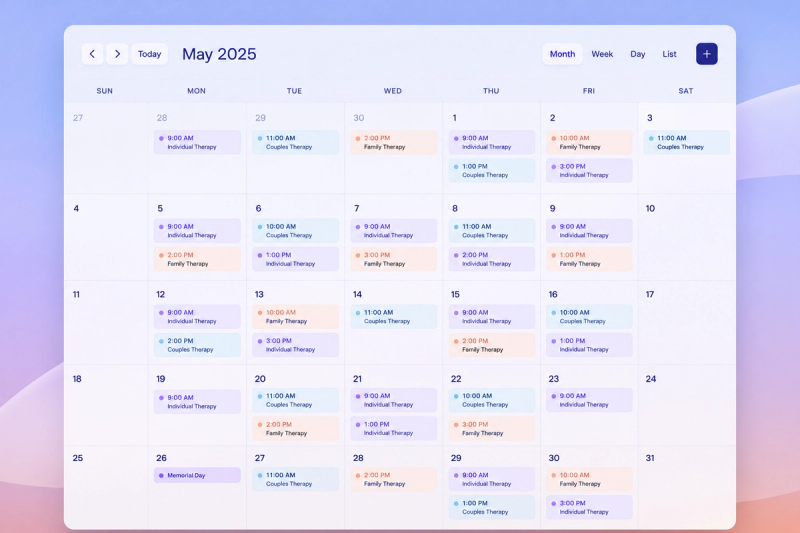
The group-practice scaling wall: what breaks at 5, 15, and 30 clinicians
Solo-built EHRs break at predictable thresholds. Here's what fails at 5, 15, and 30 clinicians — and the architecture gaps behind it.

Documentation burden in behavioral health: the hidden cost of manual notes
Manual therapy notes cost clinicians 6–8 unbillable hours every week. Here's what documentation burden actually costs your practice.