Is it actually safe to use AI for therapy notes?
Safety depends on the tool, not the category
 Mohamed Badran5 min read
Key takeaways
- AI transcription doesn't require storing session audio
- Per-client consent toggles are possible — and advisable
- Transcripts that persist are potentially discoverable by subpoena
- A signed BAA should prohibit session content from training AI models
- Test AI notes against your real caseload, not just easy note types
Using AI for therapy notes can be HIPAA compliant, but compliance is a property of the specific tool and its contracts, not of "AI" as a category. The safety question resolves to three concrete facts you can verify with any vendor: whether session audio is stored, whether the transcript persists, and whether your client content is used to train models.
Why this question matters now
AI documentation has moved from novelty to default expectation, and clinicians are right to interrogate it before trusting it with the most sensitive records in medicine. The tension is real: the time savings are significant, but a therapy note carries content that can be subpoenaed, breached, or repurposed in ways a billing record never could.
This post draws on Oasys's proprietary knowledge: direct, ongoing conversations with practicing therapists and practice owners, plus our seat at the infrastructure layer of real practices, where we see how documentation, billing, and consent actually work day to day. Across customer conversations covering dozens of practices and clinicians, AI documentation is the most-discussed feature in every demo, and the same privacy questions surface nearly every time: is the session being recorded, what happens to the audio, and can individual clients opt out. The hesitation is not opposition to the technology. It is the absence of a clear answer to those three questions.
That is the distinction this piece turns on. The risk is not the technology. The risk is an underspecified tool. "AI is unsafe for notes" is mostly a question that has not been asked precisely.
Below we walk through five things therapists commonly get wrong about AI notes and privacy, and what actually happens to the data in each case.
Myth 1: AI therapy notes require recording the session
They do not. A well-built scribe transcribes text in real time and never stores the audio at all, which means there is no recording to leak, subpoena, or retain.
This is the most common misconception, and it surfaces in nearly every demo: therapists and clients conflate "transcription" with "recording." They are different operations. Transcription converts speech to text in the moment. Recording implies a stored audio file that lives somewhere afterward.
Other platforms may be built differently. Oasys does not store audio: it transcribes during the session, and the audio is gone when the session ends. That is the right question to ask any vendor, because the answer determines whether an audio artifact of your sessions exists anywhere at all.
Myth 2: Consent for AI is a practice-wide setting, so if you use it, all clients are on it
Per-client consent is both possible and advisable. A practice-wide on/off switch is a design limitation, not a requirement.
Practices have mixed caseloads. A client with paranoia, a trauma history, a high-profile role, or simply a principled objection to AI should be able to decline without affecting anyone else's care. Granular per-client toggles are the correct model.
Other platforms may be built differently. The standard you want is a control that lives at the level of the individual client, not the whole practice. If declining AI for one client means turning it off for everyone, the tool is forcing a policy decision that should be a clinical one.
Myth 3: The transcript stays in the system after the note is signed
Whether a transcript persists after note completion is a vendor decision, not a fixed property of AI tools. This matters legally, because transcripts that persist are potentially discoverable.
Other platforms may be built differently. Oasys removes the transcript from the medical record one the note is signed and locked, so what remains is the finished clinical record, not a verbatim log of everything said in the room.
The legal exposure is concrete. A persisted transcript is a second, more detailed record of the session that can be reached by subpoena. Clinicians working with sensitive populations, including those who have asked us directly about subpoena risk, should confirm the deletion lifecycle with any platform they use, in writing.
Myth 4: The AI signs off on the note for you
It does not. The AI produces a draft. Nothing gets finalized, billed, or signed without a clinician doing it.
This one comes up as a worry about authorship. Clinicians picture a system that generates a note, closes it out, and leaves them holding responsibility for language they never chose. That is not how a documentation tool works. You are the author of the note. The scribe drafts, the same way a template or a carried-forward prior session drafts.
The practical version of the concern is more specific: can you change the wording, cut a section, or rewrite the whole thing before you sign. The answer should be yes on all three.
Other platforms may be built differently. In Oasys the draft is fully editable until you sign it, the signature is yours, and the note is not locked or attached to a claim until then. Ask any vendor two questions: can a note be signed without a clinician doing it, and can I edit any part of the draft before signing. A clear no and a clear yes are the answers you want.
Myth 5: If AI notes need too much correction, they are not worth the time
This objection is real and fair: a tool that requires heavy fact-checking on every note doubles the work rather than reducing it. The right benchmark is whether the output requires less total time than writing from scratch, across your actual note types.
Performance is not uniform across documentation. Checkbox-heavy mental status sections and highly structured assessments are harder for AI than narrative progress notes. Understanding where a specific tool performs well is more useful than a blanket verdict.
So test it against your real caseload. If a tool saves time on your progress notes but not your structured intakes, that is useful information, not a reason to dismiss the whole category.
So, is it safe?
Safety is verifiable, not assumed. A tool is safe to use for therapy notes when you can confirm each of the following, in writing:
- Audio: the session audio is not stored after the session ends.
- Consent: clients can opt in or out individually, not just practice-wide.
- Transcript: the transcript has a defined deletion lifecycle (Oasys deletes it once the note is signed and locked; other tools vary).
- Training: a signed BAA prohibits session content from being used to train or improve models.
- Fit: the output saves total time on your actual note types, not just the easy ones.
If a vendor answers all five clearly, AI notes are as safe as the rest of your compliant EHR. If a vendor hedges on any of them, the hedge is the signal.
Frequently asked questions
- Is it HIPAA compliant to use AI for therapy notes?
It can be, provided the vendor signs a Business Associate Agreement (BAA) and the AI subprocessor handling PHI is covered by it. HIPAA does not prohibit AI; it requires that any party touching PHI be contractually bound to protect it. Compliance is a property of the specific tool and its contracts, so verify the BAA rather than trusting the label.
- Does AI store or delete my session audio?
That depends on the tool, which is exactly why you should ask. Other platforms may be built differently; Oasys does not store audio at all, transcribing during the session so the audio is gone when the session ends. Ask any vendor directly whether an audio file persists after the session.
- How do I get client consent for AI note-taking?
Obtain informed consent before the first session where AI is used, ideally documented in your intake paperwork, and offer it on a per-client basis. The best practice is a granular toggle so individual clients can decline without affecting your other clients. A practice-wide on/off switch is a design limitation, not a consent requirement.
- Is my session transcript discoverable by subpoena?
A transcript that persists in the system is a record and is potentially discoverable. The protection is a defined deletion lifecycle: Oasys deletes the transcript once the note is signed and locked, while other tools vary. Confirm the deletion policy in writing, especially if you work with sensitive populations.
- Does AI use my notes to train its models?
Only if the vendor agreement allows it. A BAA with the AI subprocessor should contractually prohibit using PHI for model training, so ask plainly: "Is any audio, transcript, or note content used for model training or improvement?" If the answer is unclear or hedged, treat that as a no-go.
Safety here is not a leap of faith. It is a short list of questions with verifiable answers, and the vendors worth trusting are the ones who answer them plainly.
Related articles
Our Clinicians Are Burning Out on Documentation: What Actually Fixes It
Documentation burnout is not solved by writing faster. It is solved by closing the gap between the session and the note, and the backlog that gap creates.
SOAP Notes vs DAP Notes: Which Should You Use?
DAP is SOAP with the Subjective and Objective sections merged into one. The real question is which format fits how you think through a session.
How Does Wearable Data Help Clinicians Track Treatment Progress Between Sessions?
Most of what a clinician knows about a client's week comes from memory, reconstructed at the next session. Wearable data replaces that reconstruction with a pattern.
Which Behavioral Health EHRs Integrate With Wearables?
Ask most behavioral health EHRs whether they integrate with wearables and the honest answer is no. Here is what real integration looks like where it exists.
Best Billing Software for Behavioral Health Practices (2026)
The best billing software for a behavioral health practice is judged by what happens after a claim is submitted, not before. A guide to eligibility, denials, and real cost.
Should a Group Practice Buy a Standalone AI Scribe or an EHR With AI Built In?
A standalone scribe adds a second vendor touching every session. An EHR with AI built in keeps the note, the chart, and the claim in one system.
How Group Therapy Practices Reduce Insurance Claim Denials
Most denials are not random payer behavior. They trace back to a handful of preventable causes, and each one has a specific, checkable fix.
Best Practice Management Software for Therapists (2026)
The best practice management software for therapists depends on clinician count, not features on a marketing page. A guide to what actually separates the options at each stage.
Can AI Write Therapy Notes That Hold Up to an Insurance Audit?
An auditor does not check whether AI wrote a note. They check whether a clinician actually reviewed it, signed it, and whether it supports the billed code.
Does Your EHR Track Supervision Hours Toward Licensure?
No. Your EHR almost certainly does not accumulate supervision hours toward a licensing board, and Oasys does not either.
HIPAA Compliant Therapy Platform: What to Actually Verify (2026)
"HIPAA compliant" is not a certification a vendor earns once. It is a signed BAA plus specific, checkable safeguards. Here is what to actually verify before you sign.
Superbills for Therapists: What They Are and When to Use One
A superbill is an itemized receipt a client submits to their own insurer for reimbursement. Here is what has to be on one, and when a practice needs them at all.
Individual Therapy Billing: CPT 90837, 90834, and 90832 Explained
CPT 90837 covers individual psychotherapy of 53 minutes or more. Here is how it differs from 90834 and 90832, and why 90837 draws more payer scrutiny than either.
TheraNest vs SimplePractice: Which Is Better for Your Practice?
TheraNest prices on active clients rather than seats, which suits fluctuating caseloads. Plus a migration warning worth reading before you commit.
How IM+CANS batch export works, and why double entry isn't required
Getting a completed IM+CANS assessment into Illinois HFS's provider portal does not have to mean retyping the same client's data a second time.
Best EHR for IM+CANS (IMCANS) in Illinois (2026): what actually matters
The best IMCANS EHR is not the one with an IM+CANS-shaped form. It is the one that treats IM+CANS as five separate problems stacked together: the roughly 700-field instrument…
What IM+CANS (IMCANS) actually requires from an Illinois practice
IM+CANS is not optional paperwork. It is the single instrument the Illinois Department of Healthcare and Family Services (HFS) designated for Integrated Assessment and Treatment…
How to Grow a Group Therapy Practice From 5 to 25 Clinicians Without It Breaking
The practice does not break from headcount. It breaks from the workflows that were fine at 5 clinicians and were never redesigned for 15 or 25.
Credentialing vs. Payer Enrollment vs. Clearinghouse Enrollment: Why They're Not the Same
Credentialing, payer enrollment, and clearinghouse enrollment are three separate steps that happen in sequence, not one process with three names.
The Weekly KPIs a Group Therapy Practice Owner Should Actually Watch
A group therapy practice owner should watch four numbers every week: utilization, no-show rate, caseload per clinician, and billing health.

TheraPlatform vs SimplePractice: Which Suits Your Practice?
TheraPlatform was built around teletherapy rather than retrofitted for it. Whether that is worth it comes down to one number, your virtual share.

TheraNest Reviews: What Therapists Actually Say
Active-client pricing makes TheraNest cheaper for variable caseloads. Reviews are solid on function, softer on polish, and mixed on migration.
Sessions Health Reviews: What Therapists Actually Say
Reviewers consistently praise price, simplicity and support. The one consistent criticism is reporting, and whether that matters depends on your size.
Jane App Reviews: What Therapists Actually Say
Praise concentrates on scheduling and running a mixed clinic from one system. Criticism concentrates on mental health depth and treatment plans.
Sessions Health vs SimplePractice: A Practical Comparison
Sessions Health is the better value for small practices, with free admin seats and no feature gating. The trade-off is reporting depth.
Jane App vs SimplePractice: Which Fits a Therapy Practice?
Jane wins on scheduling and multi-disciplinary clinics. SimplePractice wins on therapy-specific depth. The treatment-plan gap decides most of it.
Oasys vs TherapyNotes: Which Is Better for a Group Practice?
TherapyNotes is genuinely well built. Here is where it stops fitting a growing group practice, and what the per-transaction fees really add up to.
Oasys vs SimplePractice: Which Is Better for a Group Practice?
A straight comparison for practices with five or more clinicians, covering supervision, permissions, payroll and what switching actually involves.
SimplePractice Reviews: What Practices Actually Say in 2026
SimplePractice is excellent for solo therapists and strains for group practices. What practices praise, what they criticise, and where the line falls.
SimplePractice vs TherapyNotes: An Honest Comparison for 2026
Two good products that break in the same place. An honest comparison of pricing, supervision and billing, with our own stake clearly labelled.
SimplePractice Alternatives for Group Practices
Why group practices outgrow SimplePractice, what the realistic alternatives are, and how to move eight years of records without breaking the practice.
What SimplePractice and TherapyNotes Actually Cost a Group Practice
The subscription is the smallest part of the bill. What group practices actually pay once per-claim fees, text charges and workarounds are counted.
Best EHR for Group Therapy Practices (2026)
Group practices break in predictable places as they grow. A ranked guide organised around what fails at five, fifteen and thirty clinicians.
Mental Health EHRs: The Complete Comparison Guide (2026)
There is no best mental health EHR, only a best one for your size. A guide organised by practice size, with five tests demos are not designed for.
Mental Health EHR Requirements: What to Actually Demand
The requirements that actually matter, grouped by what breaks at five, fifteen and thirty clinicians, plus a ten-item checklist to run live in a demo.
Mental Health Treatment Plan Examples
The four parts of a usable plan, worked examples for anxiety, depression, trauma and substance use, and the goal formula that makes progress notes write themselves.
Group Therapy Billing: CPT 90853, 90847, and 90846 Explained
CPT 90853, 90847 and 90846 explained, plus the five-minute test that shows whether your EHR can actually bill a group session without manual work.
DAP Notes: Format, Examples, and When to Use Them
Data, Assessment, Plan. A worked example, how DAP compares with SOAP and BIRP, and the mistakes that make notes fail during a payer audit.
SOAP Notes: Format, Examples, and How to Write Them Faster
The four sections, a worked example with a real assessment, and why notes take so long. Hint: it is almost never the template that slows you down.
How Tate Psychotherapy left SimplePractice without missing a session
How a solo NYC psychotherapy practice switched from SimplePractice with zero missed sessions, then put notes and billing on autopilot with Oasys.
How SoCal Soul launched a fully equipped practice from day one
How a two-clinician startup launched with Oasys' Managed RCM handling all billing, and wearable health data built into the client record from day one.
How Lowry Hill got an EMR shaped around how its clinicians actually work
How an eclectic group practice moved off TheraNest, kept billing in-house on Oasys, and got custom workflows, AI documentation, and fast support.
How Camino Nuevo cut documentation time by ~40% with Oasys
How a school-based mental health program cut documentation time ~40%, saved clinicians 8–9 hours a week, and fully onboarded in under one week.

Is it actually safe to use AI for therapy notes?
AI therapy notes can be HIPAA compliant, but safety depends on the tool, not the category. Here are three facts to verify with any vendor.

What actually goes wrong when therapy practices switch EHRs
EHR migrations fail before the data moves. Here's what actually breaks — consent gates, lost calendars, flattened notes — and how to clear it.

Own your brand vs. rent a network: the real economics
Therapy networks take 20–30% of billing revenue, per session, indefinitely. Here's how to decide when to rent a network and when to own your brand.
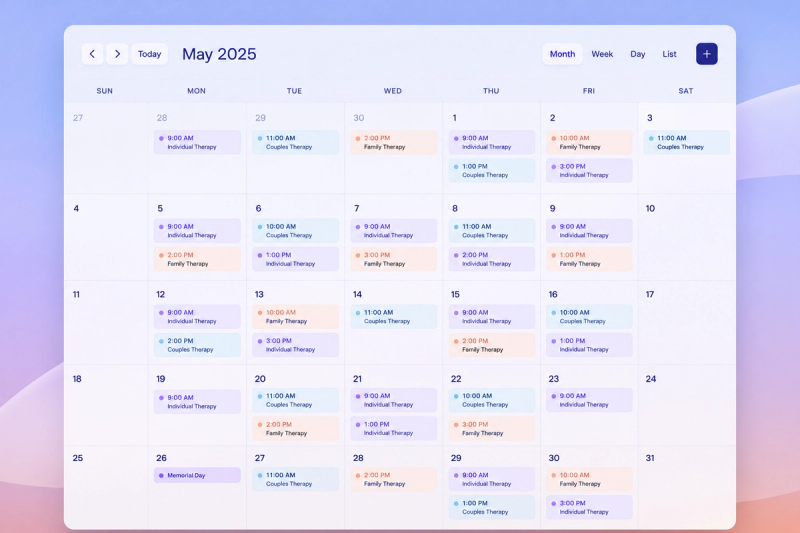
The group-practice scaling wall: what breaks at 5, 15, and 30 clinicians
Solo-built EHRs break at predictable thresholds. Here's what fails at 5, 15, and 30 clinicians — and the architecture gaps behind it.

Documentation burden in behavioral health: the hidden cost of manual notes
Manual therapy notes cost clinicians 6–8 unbillable hours every week. Here's what documentation burden actually costs your practice.